- No products in the cart.



The 15-Minute Smoke Alarm Checkup Every Home Needs

06
Aug
Smoke alarms are the cheapest life-saving device in your home — and the easiest to forget. Most of us install them, press the button once, and never think about them again until one chirps at 2 a.m. But an alarm that’s dead, expired, or in the wrong spot can’t protect anyone. The good news: a complete checkup takes about 15 minutes, once or twice a year. Here’s exactly how to do it, and how to know when it’s time to replace a unit rather than just swap the battery.
Why a regular smoke alarm checkup matters
Working smoke alarms give your household the extra minutes needed to get out safely. The catch is that “working” isn’t a one-time status — sensors age, batteries drain, dust builds up, and homes get remodeled so coverage gaps appear. Fire-safety authorities recommend testing every alarm monthly and doing a deeper review at least twice a year, which is why pairing your checkup with daylight-saving clock changes is such a popular habit. Fifteen minutes now is far cheaper than discovering a dead alarm the hard way.
The 15-minute smoke alarm checkup, step by step
Step 1 — Count and locate every alarm (2 minutes)
Walk the house and count your alarms against the recommended coverage: one inside every bedroom, one outside each separate sleeping area, and at least one on every level of the home, including the basement. Most homes are under-covered, not over-covered — note any bedroom or hallway that’s missing a unit so you can add one.
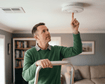
Step 2 — Press the test button on each unit (3 minutes)
Hold the test button until the alarm sounds. This confirms the horn, battery, and circuitry are working. If the sound is weak, delayed, or absent, the unit fails the test — replace the battery first, and if it still won’t sound properly, replace the whole alarm. Test interconnected alarms too: when you press one, they should all sound.
Step 3 — Check the manufacture date (2 minutes)
Take each alarm off its bracket and look at the back. Every unit is stamped with a manufacture date. Smoke alarms don’t last forever — the sensing element degrades over roughly a decade, so the standard guidance is to replace any smoke alarm that is 10 years past its manufacture date, regardless of how it sounds. Combination smoke/CO units often have a shorter service life, so check the label for the specific replace-by date.
Step 4 — Confirm you have the right type of protection (3 minutes)
There are two main smoke-sensing technologies. Ionization alarms respond a little faster to flaming, fast-moving fires; photoelectric alarms respond faster to smoldering fires like a couch or mattress. Because you can’t predict which kind of fire you’ll face, safety experts recommend having both technologies in the home — or choosing dual-sensor alarms that combine them in one unit. While you’re at it, confirm you have carbon monoxide coverage too (more on that below).
Step 5 — Clean and reseat (3 minutes)
Dust and cobwebs are a leading cause of nuisance alarms. Gently vacuum each unit with a brush attachment, then reseat it firmly on its bracket. For battery units, this is the moment to install a fresh battery if you haven’t in the past year — or upgrade to a sealed 10-year lithium model so you never have to think about batteries again.
How often to test and replace
- Test: press the button on every alarm monthly.
- Batteries: replace once a year in standard units (sealed 10-year units are maintenance-free).
- Whole unit: replace smoke alarms every 10 years; replace combination smoke/CO alarms on the schedule printed on the unit.
- Deep checkup: the full 15-minute review at least twice a year.
Where smoke alarms should go
Placement is as important as the alarm itself. Install a smoke alarm inside every bedroom, outside each sleeping area (like a hallway serving several bedrooms), and on every level of the home. Mount alarms high — smoke rises, so ceiling placement or high on a wall works best. Keep them away from bathrooms (steam), kitchens (cooking smoke — stay at least 10 feet from the stove), and supply vents or ceiling fans that can blow smoke away from the sensor. Interconnected alarms, where one triggers all, are the gold standard because everyone hears the warning no matter where the fire starts.
Smoke, carbon monoxide, or both?
Smoke alarms and carbon monoxide (CO) alarms protect against different dangers. CO is an invisible, odorless gas produced by furnaces, water heaters, fireplaces, and attached garages — a working CO alarm is the only way to detect it. Many homeowners simplify their setup with combination smoke/CO alarms, which cover both threats in a single unit and a single install point. If your home has any fuel-burning appliance or an attached garage, CO coverage isn’t optional.
When to upgrade instead of just replacing
If your alarms are aging out anyway, it’s worth upgrading rather than replacing like-for-like. Consider:
- Sealed 10-year lithium units — no battery changes for the life of the alarm.
- Interconnected alarms (hardwired or wireless) so every alarm sounds together.
- Voice and location alarms that announce the type and area of the hazard.
- Combination smoke/CO models to consolidate protection.
Shop smoke & carbon monoxide alarms
Ready to fill the gaps from your checkup? Browse our full range of smoke alarms, CO detectors, and combination units — from trusted brands, at wholesale prices — in one place.
Shop Smoke & Carbon Monoxide Alarms →
Frequently asked questions
How do I know how old my smoke alarm is?
Remove the alarm from its bracket and read the manufacture date printed on the back. If it’s more than 10 years old, replace it — the sensor degrades over time even if the unit still beeps when tested.
Why does my smoke alarm chirp when the battery is new?
A persistent chirp with a fresh battery usually means the unit has reached the end of its life or the sensor is failing. Check the manufacture date; if it’s near or past 10 years, replace the alarm.
Do I need both smoke and carbon monoxide alarms?
Yes. They detect different hazards. The simplest solution is a combination smoke/CO alarm, especially in homes with gas appliances, a fireplace, or an attached garage.
Where should I never put a smoke alarm?
Avoid within 10 feet of a stove, directly in bathrooms or steamy areas, and beside supply vents or ceiling fans that can push smoke away from the sensor — all common causes of false alarms.
A 15-minute checkup, twice a year, keeps the cheapest safety device in your home doing its job. Put it on the calendar with your clock changes and it’ll never slip again.